 Free shipping for all U.S. orders over $100


Last Updated: November 15, 2026
Quick Summary
Buying pellet stove parts wholesale lets service technicians stock the high-failure components, igniters, auger motors, blowers, and proof-of-fire switches, at trade cost so a stocked part pays for itself on the first avoided second trip. Match part numbers and models against a parts diagram before ordering, then set reorder points around your real failure rate and supplier lead times.
- The pellet heating stove market reached $512.2 million in 2024 and is projected to grow at a 5.00% CAGR through 2031.
- Stock at least one combustion blower and one convection blower for the brands you service most.
- Match the part number first, the model second, and the photo last when ordering.
- Log every part you replace for 30 days by brand, model, and part number to build your stock list.
- Confirm the return window and who covers shipping on a defective part before opening a trade account.
Table of Contents
- Why Pellet Stove Parts Wholesale Buying Changes Your Service Business
- Pellet Stove Replacement Parts Every Technician Should Stock
- Pellet Stove Parts by Brand: Matching Make and Model Before You Order
- How a Pellet Stove Parts Diagram Speeds Up Fitment Checks
- Buying Pellet Stove Parts Online: What to Verify on a Supplier Site
- Wholesale Pricing, Bulk Ordering and Inventory Planning for Service Techs
- Warranty, Returns and Defective-Part Handling on Trade Accounts
- Setting Up Your Professional Parts Account With Total Hearth
- Frequently Asked Questions
Why Pellet Stove Parts Wholesale Buying Changes Your Service Business
The pellet heating stove market reached $512.2 million in 2024 and is projected to grow at a 5.00% CAGR through 2031, according to Cognitive Market Research's market analysis. Every one of those stoves eventually needs a blower, an igniter, or a control board. For a closer look at where professionals source these parts, see where do professionals buy wholesale fireplace parts.
Buying wholesale shifts three things: cost per job, how many parts you keep on the truck, and how fast you close a call.
Below are seven moves that turn parts buying into a competitive edge.
Pellet Stove Replacement Parts Every Technician Should Stock
The right stock mix covers the failures you see most: ignition, fuel feed, airflow, and control. Major online suppliers already carry over 5,000 individual OEM and aftermarket pellet stove parts, per Stove Parts Unlimited's inventory data, so availability is rarely the problem.
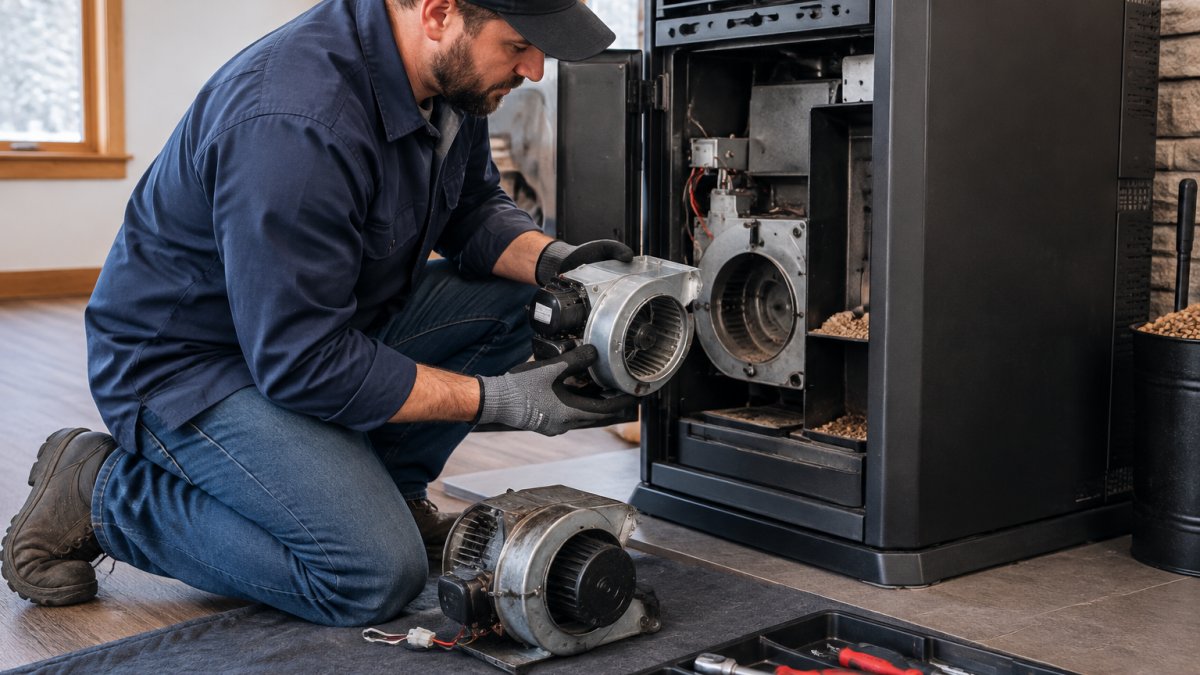
Igniters, Auger Motors and Feed Systems
Igniters and auger motors fail first because they run hardest. Keep a small reserve of both plus the feed components that wear alongside them. A failed igniter means a cold start; a stalled auger means no fuel reaches the firepot. Our guide on how to troubleshoot pellet stove igniter failure separates a dead igniter from a control or feed problem.
Blowers, Combustion Fans and Exhaust Components
Blowers move the heat and clear the exhaust, so a weak motor shows up as poor heat or soot. Stock at least one combustion blower and one convection blower for the brands you service most. The NBK 20051 exhaust blower motor at $146.99 is a genuine OEM replacement cross-compatible with Breckwell, Enviro, Regency, Hudson River, VistaFlame, and USSC part numbers, which makes it a smart single SKU to carry. For step-by-step fitment and install details, see our pellet stove blower motor replacement guide.
Control Boards, Gaskets, Probes and Firepots
These are the parts that cause repeat callbacks when they are wrong. Gaskets seal the firebox, probes read temperature, and firepots take direct heat. A faulty proof-of-fire switch is a common culprit behind blowers that never engage; the Low Limit Thermodisc 80610 at $24.99 is an OEM US Stove part that fits many Ashley, Breckwell, and USSC stoves. Carry a few.
| Component | Typical Failure Sign | Stock Priority |
|---|---|---|
| Igniter | Cold starts, no ignition | High |
| Auger motor | No fuel feed, jammed auger | High |
| Combustion blower | Weak draft, soot buildup | High |
| Proof-of-fire switch | Blower never engages | Medium |
| Gaskets and probes | Air leaks, false readings | Medium |
Pellet Stove Parts by Brand: Matching Make and Model Before You Order
Brand and model matching is the biggest source of wrong-part returns. Pellet stove parts by brand vary in mounting, wiring, and part numbers even when two motors look identical. Confirm the make, model, and original part number against the stove's data plate, not from memory.
The Harman 3-21-08639 exhaust fan motor at $199.88 fits a long list of Harman steel and cast iron models, but the impeller is sold separately and must match the stove. When you are weighing original equipment against a compatible alternative, our OEM vs aftermarket fireplace parts guide lays out the trade-offs before you commit.
The rule we give every tech: match the part number first, the model second, and the photo last. Never the other way around.
How a Pellet Stove Parts Diagram Speeds Up Fitment Checks
A pellet stove parts diagram turns a guess into a verified fit, showing how a component mounts, what it connects to, and which fasteners and impellers belong with it. Technicians who check it before ordering cut wrong-part returns dramatically.
- Pull the stove's model and serial from the data plate.
- Find the exploded diagram for that model.
- Locate the failed component and note its callout number.
- Cross-reference the callout to the part number.
- Confirm any companion parts, like an impeller or gasket, on the same diagram.
- Order the part and its companions together.
That last step matters. A draft inducer blower motor like the 115V A163 draft inducer at $169.99 replaces Fasco, Lennox, Emerson, and Rotom numbers, but hardware is not included.
Buying Pellet Stove Parts Online: What to Verify on a Supplier Site
Verify four things on any supplier site before you trust it with a service account: real part numbers, compatibility notes, OEM or aftermarket status, and a clear returns policy. A site that lists a part without cross-reference numbers will send you the wrong one.
Look for suppliers that publish OEM equivalents, model compatibility lists, and specs like voltage and RPM. Our article on how to avoid poor quality stove parts when you repair covers the quality signals that separate a reliable supplier from a risky one.
Fitment Support and Cross-Reference Help
For a service technician, the most valuable feature on a supplier site is fitment support, not price. A supplier who publishes exploded parts diagrams, cross-reference lookup by OEM number, and model-number search saves diagnostic time. Before opening an account, test the site with a part you know well: search by the OEM number, then by the stove model, and see whether the results agree.
Ask whether support staff can help confirm a fit before you order.
Stock Depth, Backorders, and Fulfillment Speed
Stock depth most affects technician scheduling and is the hardest to judge from a product page. A part that shows in stock but ships in five days is effectively a backorder.
Fulfillment speed is the other half. A supplier who ships same day on orders placed before a published cutoff lets you order in the morning and install the next day; one who batches orders twice a week adds days to every job.
Comparing Suppliers Side by Side
The fastest way to choose a supplier is to compare them on the factors that affect your schedule and margin, not the headline price of a single part. Score the two or three suppliers you are considering on the same criteria:
- Trade pricing: base discount, tier thresholds, and whether OEM parts are included.
- Inventory depth: how many of your top 10 parts are in stock today, and how often they go on backorder.
- Fulfillment: cutoff time, ship method, and typical delivery window to your area.
Run the comparison against your actual top 10 parts, not a sample the supplier chooses. A supplier who wins on price but loses on stock depth and fulfillment costs more in rescheduled calls than the discount saves; one slightly higher on price who ships same day and confirms fitment pays for the difference on the first avoided second trip.
Wholesale Pricing, Bulk Ordering and Inventory Planning for Service Techs
Wholesale pricing only pays off when it matches your actual failure rate. Bulk ordering lowers your cost per part, but overstocking ties up cash in components that sit on a shelf.
Individual parts give you a sense of the math. A replacement baffle board runs about $124.95 and an exhaust combustion motor about $184.95, per Pellet Stove Pro's component pricing.
How Trade Pricing Actually Works
Wholesale pricing for service technicians is rarely a single discount off list. Ask a prospective supplier three questions: what the tier thresholds are, whether the discount applies to every brand or only house brands, and whether the rate resets monthly or accrues over a quarter.
Minimum order requirements matter as much as the discount. A deep discount with a high minimum can cost more than a modest discount with no minimum if you only need two igniters this week. Compare effective cost per part at your real order size.
The Carrying-Cost Math
Stocking parts is not free. Every part on the shelf ties up cash, takes space, and risks obsolescence if a model line is discontinued.
Sort your parts into three buckets:
- Fast movers: igniters, auger motors, combustion blowers, and proof-of-fire switches for the two or three brands you service most. Stock these deep enough to cover a typical week.
- Steady movers: gaskets, probes, and firepots. Stock a modest reserve and reorder on a set schedule.
- Slow movers: control boards, draft inducers, and model-specific impellers. Order per job unless a customer base justifies a single spare.
Building a Model-Specific Stock Plan
Start with a simple count. For 30 days, log every part you replace by brand, model, and part number. Rank the list by frequency and by the cost of a second trip.
Then set reorder points: the stock level that triggers a new order before you run out, accounting for lead time. If a supplier ships in two days and you use one igniter a day, a reorder point of four covers a weekend.
Warranty, Returns and Defective-Part Handling on Trade Accounts
Before you open a trade account, confirm the return window and who covers shipping on a defective part.
A 2026 ServiceTrade survey of 823 service technicians found that operational friction in daily workflows is a major source of job frustration, even among techs who love the work itself. A supplier who resolves defects fast removes one more piece of that friction.
Setting Up Your Professional Parts Account With Total Hearth
A professional account is the last move and the one that ties the others together.
We provide expert technical guidance and fast, reliable shipping. We are a member of the HPBA, NFIB, and NGA, and hold a 4.8/5 average rating across 2,486+ reviews.
Here is what to have ready when you set up a trade account:
- Your business name and contact details
- The stove brands and models you service most
- Your top replacement parts by frequency
The difference between a repair business that grows and one that stalls often comes down to parts.
Frequently Asked Questions
Where can service technicians buy pellet stove parts wholesale?
Specialist parts distributors are the usual route. Look for a supplier that stocks components across many brands and publishes cross-reference part numbers. Total Hearth sells direct to homeowners and service professionals and carries blowers, motors, gaskets and electrical components for wood, pellet and gas appliances. Before you commit, confirm the supplier lists your most-serviced brands by name and model, and ask how they handle a wrong or defective part.
What pellet stove parts should technicians keep in stock?
Start with the components that fail most often on the models you service: igniters, auger and feed motors, combustion and convection blowers, proof-of-fire snap discs, door and hopper gaskets, and firepot parts. A low-limit thermodisc such as the 80610 at $24.99 is an OEM US Stove part that fits compatible Ashley, Breckwell, and USSC pellet stoves. Blowers cost more, so stock only the two or three part numbers that match your highest-volume brands, then order the rest per job.
How can I identify the correct replacement part for a pellet stove?
Work from the data plate on the appliance, not the homeowner's description. Note the make, model and serial number, then pull the parts diagram for that exact model and read the item number off the diagram before searching. Cross-reference the OEM number against the supplier listing. A listing that names the brands and part numbers it replaces, such as a blower that lists Breckwell A-E-027 and Enviro 50-901, gives you a second check before you order.
Can I order pellet stove parts online for professional repairs?
Yes, and most technicians do. The checks that matter are fitment data and returns policy. Confirm the listing shows the OEM part numbers it replaces, the electrical specs (voltage, amperage, RPM) and the models it fits. Then read the return window and the defective-part terms. Total Hearth backs its NBK 20051 exhaust blower motor with a 30-day money-back guarantee, which is the kind of term worth comparing across suppliers before you place a bulk order.
