 Free shipping for all U.S. orders over $100


Table of Contents
- Pellet Stove Blower Motor Troubleshooting: Diagnosing the Problem
- Pellet Stove Blower Motor Replacement Parts: Finding the Right Fit
- Safety First: Essential Precautions Before You Start
- Pellet Stove Blower Motor Installation: A Step-by-Step Guide
- Pellet Stove Blower Motor Cleaning: Maintenance for Longevity
- Testing Your Repair and When to Call a Professional
- Conclusion: Keeping Your Pellet Stove Running Smoothly
- Frequently Asked Questions
Last Updated: October 5, 2026
Pellet Stove Blower Motor Troubleshooting: Diagnosing the Problem
A pellet stove blower motor replacement guide starts with one question: is the blower actually the problem? At Total Hearth, we talk to homeowners every week who ordered a new motor before checking the simple stuff. Most of the time, the real fix is a cleaning, a loose wire, or a bad gasket.
A blower motor is the fan that pushes air through your stove. Pellet stoves use two of them, and they do very different jobs.
Identifying Your Blower Type: Exhaust vs. Convection
Your stove has two blowers, and they fail in different ways.
- Exhaust blower (combustion fan): pulls smoke out of the fire pot and up the vent. Runs constantly during a burn.
- Convection blower (room-air blower): pushes heated air into the room. Cycles on and off with the temperature.
Here's how to tell which one is bad:

- Smoke backing into the room or a lazy flame points to the exhaust blower.
- Weak airflow from the vents, but a good flame, points to the convection blower.
- A loud grinding or screeching noise can come from either one.
Unplug the stove and spin each fan blade by hand. A rough, gritty feel means worn bearings. A blade that won't turn at all means the motor is seized.
Pellet Stove Blower Motor Replacement Parts: Finding the Right Fit
Finding the right replacement part comes down to three numbers: your stove's model number, the old motor's part number, and the motor's specs.
Start with the data plate. It's a metal tag on the back or side of the stove, and it lists the make and model. Write both down exactly.
Next, pull the old motor and read its label. You're looking for:
- Part number (often an OEM number like A-E-027 or 3-21-08639)
- Voltage (most pellet stoves run on 115V or 120V AC)
- Frequency (60 Hz in the U.S.)
- RPM (speed, often 3000 or 3400)
- Rotation direction and shaft size
- Mounting pattern (the distance between screw holes and the bracket shape)
- Connector type (the plug or terminal style that mates with your stove's wiring harness)
- Fan wheel size and blade count
An OEM part is made by the original manufacturer. An aftermarket part is made by another company to the same spec. Both can work well. What matters is the match.
How to Read Motor Specs: Voltage, RPM, and Horsepower
Voltage and RPM matter more than horsepower on most pellet stoves.
- Voltage: Must match. A 115V motor on a 115V circuit is correct. Never substitute a 230V motor.
- RPM: Match as closely as you can. A big drop in RPM weakens your draft.
- Horsepower: Close is fine here. Small differences rarely matter.
- Shaft and mounting: Must line up with the old motor's bracket and fan.
- Rotation: The motor must spin the same direction as the old one. If the label says CW (clockwise) or CCW (counterclockwise), match it.
- Connector: The plug must fit your stove's harness. If it doesn't, you may need an adapter or to splice wires, which is a job for a technician.
Universal Compatibility Checklist
Before you order, run through this list. If any item doesn't match, the motor may not work or may fail early.
- Model and serial number from the data plate match the part listing
- Voltage and frequency match (115V/120V, 60 Hz)
- RPM is within a small range of the original
- Rotation direction matches
- Shaft diameter and length match
- Mounting holes line up with the bracket
- Connector type matches your wiring harness
- Fan wheel size and blade count match
- Gasket or seal is included or available separately
Safety First: Essential Precautions Before You Start
Before you touch anything, cut the power. Unplug the stove from the wall, or switch off the breaker that feeds it. Then wait. The stove body and the fire pot stay hot for a long time after shutdown.
Follow these rules every time:
- Let the stove cool completely, at least two hours
- Unplug the power cord or trip the breaker
- Shut off the fuel feed and empty the hopper if you can
- Wear safety glasses and a dust mask
- Wear work gloves to protect against sharp metal edges
- Work in a well-ventilated space
- Keep a fire extinguisher within reach
- Never bypass a safety switch or jumper a wire to "test" the stove
The National Fire Protection Association publishes NFPA 211, the standard for chimneys, fireplaces, vents, and solid fuel appliances. It's the reference your local code official uses, and it's worth a look before any venting work.
If you see melted wire nuts, scorched insulation, or a burned connector, stop. That's a sign of an electrical fault that a new motor won't fix. Call a licensed technician.
Pellet Stove Blower Motor Installation: A Step-by-Step Guide
Installation takes most homeowners about an hour with basic hand tools. The job is simple, but it's fiddly. Take your time and label everything as you go.
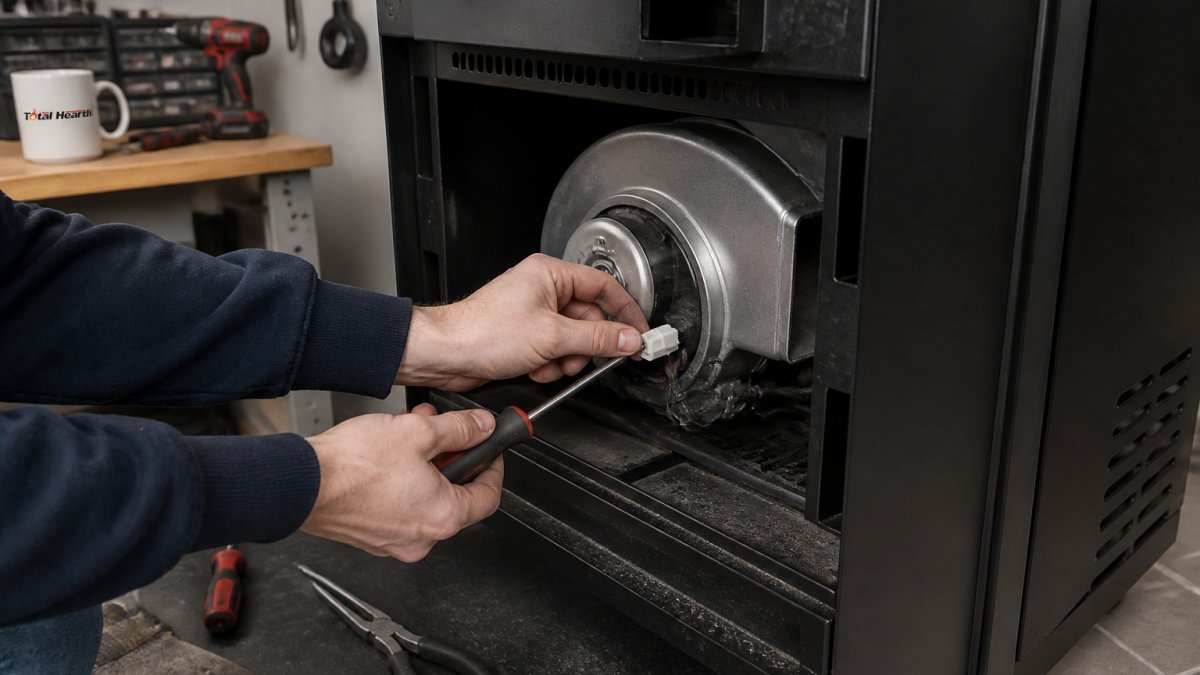
What You'll Need:
- Nut drivers or a socket set
- Screwdrivers (Phillips and flathead)
- Needle-nose pliers
- A shop vacuum with a brush attachment
- Wire labels or masking tape and a marker
- The new motor and any gaskets
Total Time: 45-90 minutes Difficulty: Beginner to intermediate
Removing the Old Motor and Installing the New One
Step 1: Access the blower [Time: 10 minutes] Remove the side or rear access panel.
Step 2: Photograph the wiring [Time: 2 minutes] Snap a photo of every wire before you disconnect it.
Step 3: Disconnect the wires [Time: 5 minutes] Pull the quick-connect terminals straight off. Don't yank on the wire itself.
Step 7: Reassemble and check [Time: 10 minutes] Replace the panel. Plug the stove back in and listen.
Expected Result: A steady flame, no smoke indoors, and strong airflow from the room vents.
Pellet Stove Blower Motor Cleaning: Maintenance for Longevity
Cleaning is the cheapest repair you'll ever do. Ash is the number one killer of blower motors. It packs into the fan blades, throws off the balance, and wears out the bearings.
Clean the blowers every time you do a full stove cleaning:
- Vacuum the fan blades with a soft brush attachment
- Wipe the motor housing with a dry cloth
- Check the gasket around the blower and replace it if it's cracked
- Clear the vent pipe and the exhaust passage
- Spin each blade by hand to check for wobble
A common mistake is using compressed air. It just pushes ash deeper into the motor. Vacuum instead.
Testing Your Repair and When to Call a Professional
Test the repair with a short burn cycle before you trust it for the night. Run the stove for 20 to 30 minutes and watch three things: flame quality, airflow, and noise.
What good looks like:
- A bright, steady flame with a small amount of ash flying up
- Strong, warm airflow from the room vents within a few minutes
- A smooth hum from both blowers, no grinding or squealing
Post-Installation Verification Checklist
Use this checklist after every blower replacement. It helps you catch problems before they become safety issues.
- Stove starts and runs without tripping a breaker
- No smoke or exhaust smell indoors
- Flame is steady and bright, not lazy or dark
- Airflow from room vents is strong and warm
- Both blowers run smoothly with no grinding, squealing, or vibration
- No unusual noises at startup or during the burn
- Vent pipe and exhaust passage are clear
- All panels and gaskets are back in place and sealed
- Wiring is secure and no connectors are loose
- Stove shuts down normally when the thermostat or switch is turned off
If the flame is lazy or smoke rolls out when you open the door, your draft is still weak. Recheck the exhaust blower wiring and the vent for blockages.

Preventive Maintenance After Replacement
A new motor will last longer if you keep the stove clean. Ash is abrasive and packs into fan blades, throwing off balance and wearing bearings.
- Vacuum the blower fan blades every few weeks during heating season
- Wipe the motor housing with a dry cloth
- Check the blower gasket and replace it if cracked
- Clear the vent pipe and exhaust passage at least once a year
- Spin each blade by hand to check for wobble or rough spots
A common mistake is using compressed air. It just pushes ash deeper into the motor. Vacuum instead.
When to Call a Professional
Call a professional when:
- You smell gas or burning plastic
- A breaker trips when the stove starts
- The control board shows an error you can't clear
- The wiring looks damaged or melted
- You're not comfortable working around 115V power
- The new motor still doesn't run after installation
- You cannot find a compatible replacement part
At Total Hearth, our team answers fitment questions before you order, so you get the right motor the first time. We stock genuine OEM parts like the NBK 20051 exhaust blower motor that cross-references to Breckwell, Enviro, and USSC part numbers, along with Harman and Fasco-compatible options.
Conclusion: Keeping Your Pellet Stove Running Smoothly
The hardest part of this job isn't the wrench work. It's the diagnosis. Get that right, and the rest is straightforward.
If you're not sure which motor fits your stove, send us your model number and a photo of the old part's label. We'll match it for you.
Frequently Asked Questions
How do I know if my pellet stove blower motor needs replacing?
Common signs include a loud grinding or squealing noise, the blower not turning on at all, or weak airflow from the vents. You might also notice the stove overheating or shutting down unexpectedly. Before replacing, try cleaning the blower and checking for obstructions. If the motor still fails to run or makes persistent noise after cleaning, it likely needs replacement.
Can I replace a pellet stove blower motor myself?
Yes, if you are comfortable with basic tools and follow safety precautions. Always disconnect power first. The process involves removing the old motor, matching specifications, and wiring the new one. However, if you are unsure about electrical work or your stove is under warranty, hire a qualified technician. This guide is for beginners, but safety should always come first.
How do I find the correct replacement blower motor for my pellet stove?
Locate your stove's model number on the rating plate, usually on the back or side. Then find the part number on the old motor itself. Use these to search for a compatible replacement. Pay attention to voltage (often 115V or 120V), RPM, and whether it's an exhaust or convection blower. If unsure, contact a parts supplier with your stove model and motor part number.
How long does it take to replace a pellet stove blower motor?
For a beginner, expect 1 to 2 hours. This includes diagnosing, gathering tools, removing the old motor, installing the new one, and testing. Having the correct replacement part and tools ready can speed things up. If you encounter rusted bolts or difficult access, it may take longer. Always work patiently and safely.
A cold snap is the worst time to discover your blower is failing. Total Hearth stocks replacement blowers, motors, and electrical components for wood, pellet, and gas appliances, with expert technical guidance and fast shipping to your door. Our team helps you confirm fitment before you buy, so you're not stuck guessing. Shop with Total Hearth and get the right part the first time.