 Free shipping for all U.S. orders over $100


Table of Contents
- Why Identifying Your Wood Stove Model Matters
- Where to Find the Wood Stove Model Number
- Identifying a Wood Stove with No Label
- Understanding the Wood Stove Identification Plate
- Finding Wood Stove Replacement Parts by Model
- Common Mistakes to Avoid When Identifying a Stove
- Safety and Certification Implications
- Frequently Asked Questions
Last Updated: October 5, 2026
Why Identifying Your Wood Stove Model Matters
Learning how to identify old wood stove model is the foundation for finding the right replacement parts.
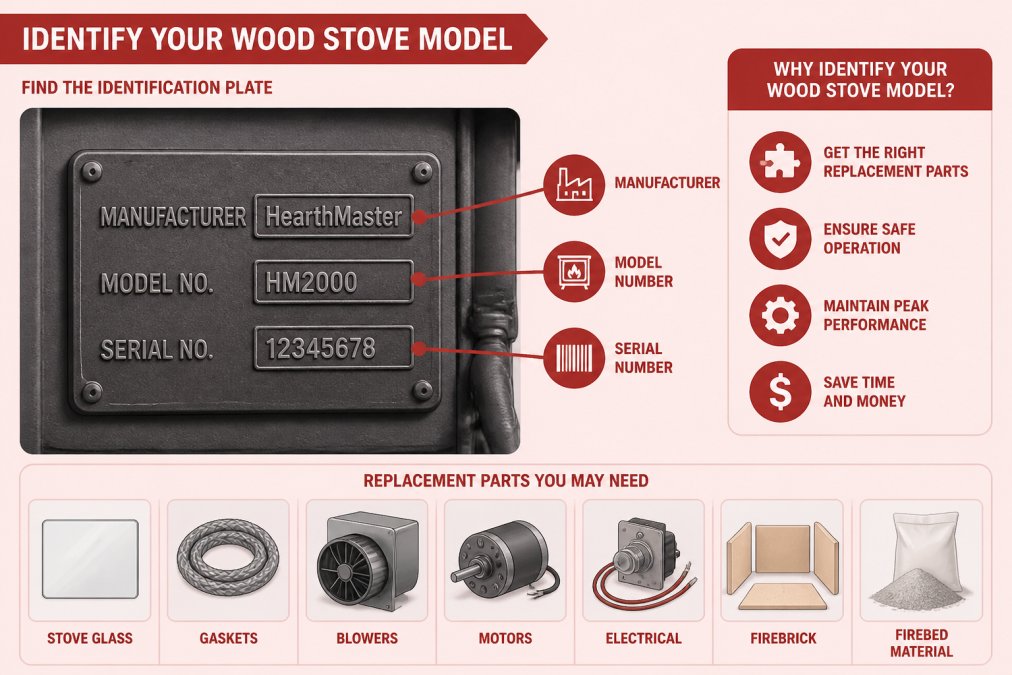
Many homeowners face this problem. A gasket fails. A door latch breaks. Glass cracks. You search online for replacement parts, but without a model number, you're stuck guessing.
At Total Hearth, we work with homeowners and service professionals who need exact matches. That's why the ability to identify old wood stove model matters so much.
Knowing your stove's model also helps you:
- Find the correct door glass, gaskets, and seals
- Locate blowers, motors, and electrical components that fit
- Access the original manual and technical specifications
- Understand your stove's age and construction details
- Verify safety ratings and certification status
Where to Find the Wood Stove Model Number
The model number is usually on a metal plate attached to your stove. This plate contains the information you need. Finding it is the first step.
Check the Identification Plate and Nameplate
Look for a metal identification plate or nameplate. These are typically mounted on the back of the stove, though some are on the side or inside the firebox door.
Check these locations first:
- Back panel, near the base or top
- Side panels, especially the left or right exterior
- Inside the firebox, on the door or chamber wall
- Bottom of the stove, if accessible
- Top surface, near the flue collar
The nameplate is usually made of cast iron or stamped metal. It won't be painted over. If you see a metal plate with lettering, photograph it. Write down every detail: the manufacturer name, model designation, any numbers, and the year if visible.
Look for Cast-In Markings and Embossed Details
Many older wood stoves have the model name cast directly into the iron body. These markings are permanent and won't wear off. Look for raised lettering or designs that spell out the manufacturer or model.
Common locations for cast-in markings:
- The door frame or door itself
- The top chamber or cooking surface
- The sides of the firebox
- Decorative castings on the front or corners
- The flue collar area
Embossed lines and maker's marks often appear as part of the stove's design. A stove with trees and log cabin motifs might have the model name worked into that design. Trace your fingers across the iron surface.
Inspect the Back, Sides, and Bottom
The back of the stove is your best bet for finding labels and markings. This area is less likely to be painted or covered. Look carefully at the entire back panel. Use a flashlight if needed.
Check the sides thoroughly:
- Left and right exterior panels
- Seams where panels join
- Areas near the door hinges
- Spots near the flue connection
If your stove sits on legs, check underneath. Some manufacturers stamped information on the bottom. You may need to move the stove or use a mirror to see this area safely.
Identifying a Wood Stove with No Label
Some stoves have lost their identification plates. Labels corrode, rust, or fall off over decades. Nameplates get painted over or removed. When the obvious markings are gone, you'll need to use other clues.
Use Visual Features and Design Details
The stove's appearance tells a story. The style, materials, and construction details narrow down the possibilities. Look at the overall design first.
Ask yourself these questions:
- Is the stove made entirely of cast iron, or does it have a steel body?
- Does it have decorative castings on the front, corners, or sides?
- What color is it? Black, brown, or another shade?
- Does it have a flat top, rounded top, or angled surfaces?
- How many doors does it have? One large door, two smaller doors, or a side loading door?
- Is there a cooking surface on top, or is the top solid?
- What style is the door frame? Ornate, simple, modern, or traditional?
Decorative castings are especially helpful. Stoves from the 1970s and 1980s often feature trees and log cabin motifs. Stoves from the 1960s might have geometric patterns. Newer stoves tend toward cleaner, simpler lines.
Measure and Compare Stove Dimensions
Dimensions help distinguish similar models from different manufacturers. Measure the stove's height, width, and depth. Measure the firebox opening. Note the flue collar diameter.
Key measurements to record:
- Overall height (floor to top of flue collar)
- Overall width (widest point)
- Overall depth (front to back)
- Firebox opening width and height
- Flue collar diameter (usually 6 or 8 inches)
- Door opening dimensions
Write these down. Then search online for stoves with similar dimensions and visual features. Manufacturer websites and replacement parts sites often list stove specifications. Compare your measurements to published specs. A match in dimensions plus matching visual features is strong evidence of the correct model.
Document Decorative Castings and Maker's Marks
Photograph every decorative element. Close-up photos of embossed designs, maker's marks, and cast-in lettering are invaluable for research. These details often appear in product catalogs and owner forums.
Take photos from multiple angles:
- Straight-on shots of the front
- Close-ups of any lettering or designs
- Side views showing the overall profile
- Detail shots of decorative castings
- Photos of the flue collar and vent connection
Share these photos in owner forums or with Total Hearth's technical team. The more photos you provide, the better your chances of a match.
Understanding the Wood Stove Identification Plate
The identification plate contains standardized information. Learning to read it saves time and prevents mistakes.
What Information to Record
A typical identification plate shows:
- Manufacturer name: The company that made the stove
- Model name or number: The specific designation for that stove
- Serial number: A unique identifier for that individual unit
- Year of manufacture: Often encoded in the serial number or listed separately
- Safety certifications: UL (Underwriters Laboratories) or other agency marks
- BTU rating: The heat output capacity
Write down everything you see, even if you don't understand it yet. The serial number is especially important. Many manufacturers encode the production year in the serial number. A service professional or parts supplier can decode this for you.
Locating Serial Numbers and Manufacture Dates
Serial numbers appear on the identification plate or stamped into the iron body. They're usually a combination of letters and numbers. The format varies by manufacturer.
Common serial number locations:
- Identification plate on the back
- Inside the firebox, on the chamber wall
- On the flue collar or collar support
- Stamped on the bottom or base
- On the door frame or hinge area
The manufacture date might be printed directly on the plate. If not, the serial number often encodes the date. For example, a serial number starting with "85" might indicate 1985. Contact the manufacturer or a parts supplier to decode your specific serial number.
Finding Wood Stove Replacement Parts by Model
Once you've identified your stove, finding the right parts becomes straightforward. Total Hearth stocks replacement components for various stove models and ages.
Verify Your Match Before Ordering
Before you order anything, confirm your identification is correct. A wrong part is a wasted order.
Verification steps:
- Compare your stove's dimensions to published specifications for the model you've identified
- Check that the visual features match photos in manufacturer catalogs or online listings
- Look for the model name on your stove again, even if it's faint
- Search for the model online and compare images to your stove
- Contact a parts supplier or service professional with your photos and measurements
Once you're confident, contact Total Hearth with your model information. Our team will confirm what parts fit your stove. We offer custom-cut ceramic, tempered, and mica glass tailored to your exact specifications. We also stock gaskets, blowers, motors, and electrical components for various stove types.
What to Do When the Stove Remains Unidentified
Some stoves resist identification. The markings are too worn. The design doesn't match any catalog. The stove might be a regional brand or a very old model.
If you can't identify your stove:
- Post photos and measurements in stove owner forums online
- Contact local chimney sweeps or fireplace repair specialists
- Reach out to Total Hearth with detailed photos and dimensions
- Search for similar stoves using visual features and measurements
- Check with antique stove dealers or restoration specialists
- Ask neighbors or the previous homeowner about the stove's history
Many unidentified stoves can still be matched by component measurements. If you need a door replacement, measure the opening precisely. If you need a gasket, measure the flue collar diameter. Total Hearth can often help find compatible parts even when the exact model remains a mystery.
Common Mistakes to Avoid When Identifying a Stove
Rushing the identification process leads to ordering the wrong parts. Take your time. Verify everything.
Common mistakes homeowners make:
- Assuming all stoves of one brand fit the same: Each model is different. Vermont Castings made dozens of models. A part for one won't fit another.
- Relying on part numbers from other sellers: Different suppliers use different numbering systems. Verify the part fits your specific model.
- Ignoring measurement differences: A door that's off by half an inch won't fit. Measure twice.
- Trusting photos alone: An online photo might look similar but be a different model. Verify dimensions and visual details.
- Ordering before confirming: Take the extra step to confirm your model with a parts supplier before placing an order.
- Missing the serial number: The serial number often unlocks the manufacture date and other key details.
- Overlooking cast-in markings: These permanent markings are more reliable than faded labels.
The best approach is methodical. Photograph everything. Measure carefully. Document your findings. Then contact a knowledgeable supplier to confirm before you buy.
Safety and Certification Implications
Your stove's model and age affect its safety and efficiency. Older stoves may not meet current emissions standards.
Many stoves manufactured before the 1990s emit more particulates than modern standards allow.
Modern stove models are designed to meet EPA (Environmental Protection Agency) emissions standards (the EPA).
Always verify that replacement parts meet safety standards. Total Hearth sources high-quality components designed to fit your stove safely and reliably.
Identifying your wood stove model is the first step toward keeping it running safely and efficiently. When you're ready to order replacement components, Total Hearth offers custom-cut glass, gaskets, motors, and electrical parts for various stove types.
Frequently Asked Questions
How can I tell what model wood stove I have?
Start by looking for an identification plate or nameplate on your stove's back, sides, or bottom. Check for cast-in lettering or embossed markings that show the manufacturer and model name. If no label exists, photograph the stove from multiple angles, document any decorative castings or maker's marks, and measure its dimensions. Search online forums or contact the manufacturer directly with these details. Recording the serial number, if visible, helps confirm the exact model and manufacture date.
Where is the model number on an old wood stove?
The model number typically appears on a metal identification plate attached to the back or side of the stove, or cast directly into the stove body. Check the back panel first, as most manufacturers place the nameplate there. Look along the sides near the flue collar, on the bottom, or inside the firebox. Some older stoves have the model name embossed into the cast iron rather than on a separate plate. If you find a serial number, that can also help identify the exact model when researching with the manufacturer.
How do I identify a wood stove if the label is missing?
Without a label, rely on physical features: document decorative castings, embossed lines, and any visible maker's marks with clear photographs. Measure the stove's height, width, depth, and opening dimensions. Note distinctive design details like door style, firebox shape, and flue connection type. Search online forums or owner communities with your photos and measurements. Compare your stove's construction details, cast iron thickness, leg style, and vent configuration, against known models. Contact the manufacturer if you can identify the brand from remaining markings, or consult a fireplace specialist who may recognize the design.
What should I record when identifying a wood stove?
Photograph the stove from the front, back, sides, and top. Record the manufacturer name, model name, model number, and serial number if visible. Note the stove's approximate age or any date markings. Document dimensions in inches (height, width, depth, and opening size). Describe distinctive features: decorative castings, door type, flue collar design, and any embossed lettering. If searching for replacement parts, this information ensures you order the correct custom-cut glass, gaskets, or other components that fit your exact stove model and specifications.