 Free shipping for all U.S. orders over $100


Quick Summary
Stove replacement parts can be bought online for a wider catalog and exact model matching, or from local hearth shops for urgent items. Many homeowners check locally first and order online when a part is hard to find.
- Find your stove's model and serial number on the appliance label before ordering any part.
- Compare a listing's replacement references with the part number in your owner's manual.
- Measure the original gasket profile and glass dimensions, since similar-looking gaskets are not interchangeable.
- Total Hearth stocks tadpole gaskets sold by the foot, plus gasket tape for sealing stove doors.
- Leave gas valves, venting and line-voltage electrical repairs to a qualified technician.
Table of Contents
- Where to Buy Stove Replacement Parts Online Versus Locally
- How to Find Your Stove Model Number and Parts Diagram
- Total Hearth Gasket Kit
- Total Hearth Ceramic Glass and Blower Controls
- Why OEM Stove Replacement Parts Matter and Where Aftermarket Fits
- Ordering the Right Stove Part from Total Hearth
- Frequently Asked Questions
Where to Buy Stove Replacement Parts Online Versus Locally
Last Updated: November 17, 2026
Finding where to buy stove replacement parts starts with one question: do you need the part today, or can you wait a few days for the right one? Total Hearth stocks gaskets, glass, blower controls and related components for wood, pellet and gas stoves, so this guide walks through the choices and shows how to pick the right part from Total Hearth.
Here is how the five main sources for stove replacement parts compare:
| Source | When to Use It | What to Verify First | Drawback |
|---|---|---|---|
| Manufacturer or authorized dealer | You need a part guaranteed to match your stove, or the unit is still under warranty. | That the dealer is listed as authorized for your brand, and that the part will not void any remaining warranty. | Often the slowest option, with longer lead times than other sources. |
| Local hearth shop | You need the part quickly, or want help identifying it in person. | That the shop services your stove brand and has the part in stock before you drive over. | Selection is limited, especially for older or less common models. |
| Specialty online hearth retailer | You know your model and part number and want a wide catalog of stove-specific parts. | That the listing's part number matches the one in your owner's manual or parts diagram. | Shipping takes time, so it is not ideal for an urgent repair. |
| Home improvement store | You need a generic item like stove paint, cement or common hardware, not a model-specific part. | That the product is actually rated for stove use, not a general-purpose substitute. | Staff usually cannot match parts to a specific stove model. |
| Online marketplace | You are searching for a discontinued or hard-to-find part from a secondary seller. | The seller's return policy, and that the listed part number and dimensions match your stove exactly. | Listings are not always accurate, and there is no manufacturer backing if the part is wrong. |
Before you buy from any source, work through this checklist:
- Find the data plate on your stove using your owner's manual as a guide.
- Record the make, model and serial number from the data plate.
- Find the original part number on your stove's parts diagram.
- Verify any replacement listing against that part number before you order.
Photos and dimensions are a useful secondary check, but they are never a substitute for matching the part number itself.
How to Find Your Stove Model Number and Parts Diagram
Before you buy anything, find the model and serial number. This is the single step that prevents most wrong orders, and it is the step most shoppers skip. A model number tells a seller which revision of an appliance you own; a serial number tells them which production run it came from, which matters when a manufacturer changed a component mid-year without changing the model name.
Where the label lives depends on the appliance type. On freestanding wood and pellet stoves, check the back panel, the underside of the firebox, and the inside of the door frame or side panel. On gas stoves and fireplace inserts, look behind the lower access panel, inside the control compartment, and along the inside edge of the firebox frame. Write both numbers down exactly as printed, including any letter suffixes, a trailing "-1" or "A" can indicate a different revision with different parts.
Next, locate the parts diagram. The owner's manual usually contains an exploded view with each component numbered and a parts list keyed to those numbers. If the manual is lost, the manufacturer's website typically hosts a model-specific diagram, and specialist parts retailers publish the same diagrams alongside their listings. A diagram is more useful than a photo because it shows how the part sits in the assembly and which fasteners or gaskets surround it.
Reading the diagram takes a little practice. Find the assembly you are repairing, door, glass, blower, burner, then trace the numbered callout to the parts list. The list gives the part number, a description, and often a quantity per appliance. Order the quantity the list specifies; gaskets and fasteners are frequently sold individually even when the diagram shows several.
Cross-referencing is where most orders go wrong. A part number on a listing may be a superseded number, a substitute, or a manufacturer's internal reference rather than the number printed in your manual. Compare the listing's stated replacement references against your manual's part number, and confirm the dimensions and profile match the original. When a listing says a part replaces an older reference, that is usually a legitimate supersession, but verify the fitment notes rather than assuming.
Measure the original piece as well, but treat this as a secondary check, not a substitute for matching the part number. Gasket profiles such as tadpole, rope and tape look similar in a photo but are not interchangeable. Confirm fit by measuring against the original part and checking the stove's appliance manual and Total Hearth's how-to-measure guide before ordering.
Watch out: a model number copied from a sales listing or a previous owner's note may not match the appliance in your home, especially on older stoves that were rebadged under multiple brand names. Always read the plate on the appliance itself.
Total Hearth Gasket Kit
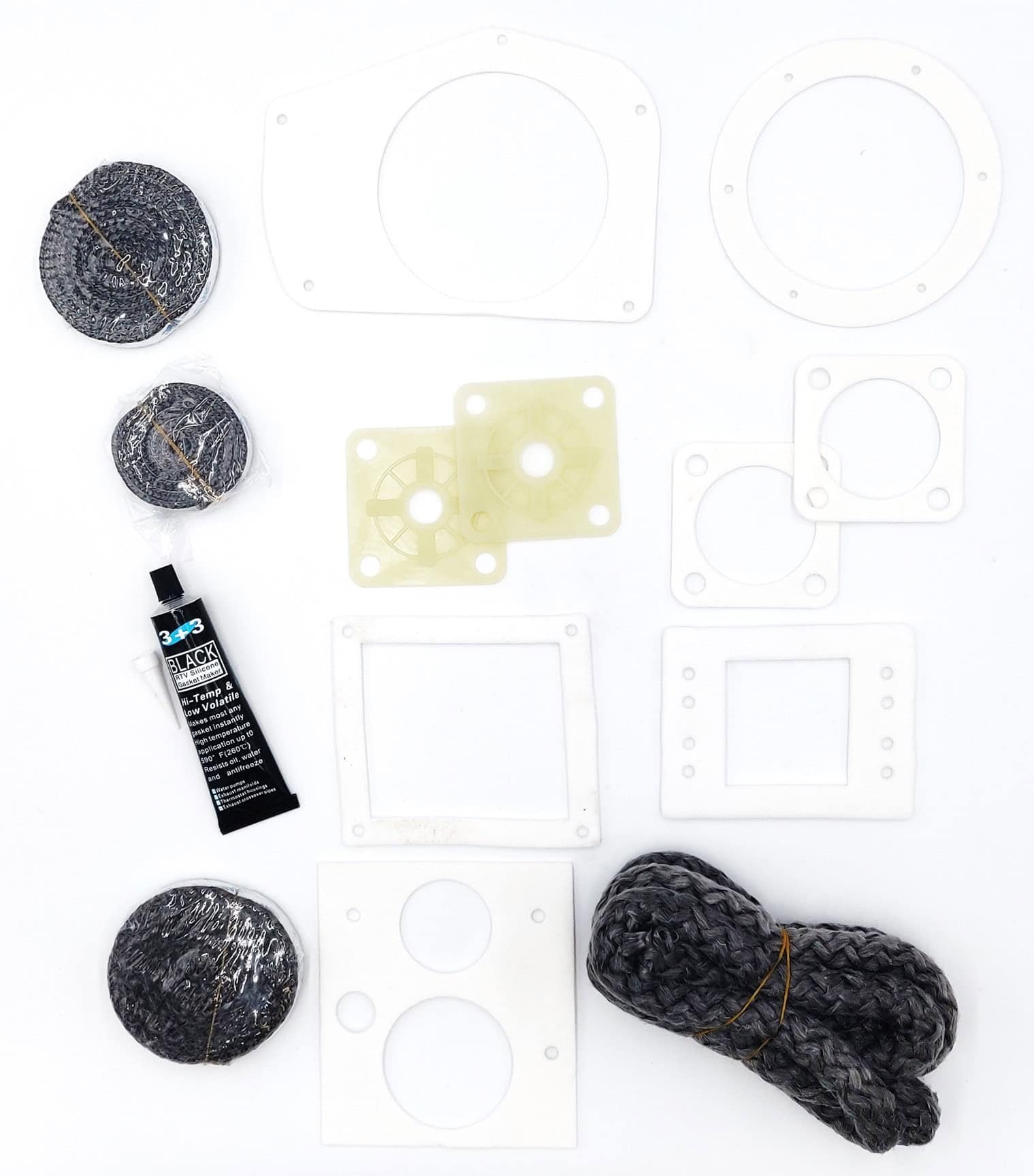
Gaskets wear out first, and they are often the cheapest fix. The example below shows a Total Hearth gasket kit. Confirm the part number matches your appliance before ordering.
The NBK-20393K Gasket Kit for Englander bundles rope, strip and shaped gaskets for servicing seals on compatible Englander appliances.
Total Hearth Ceramic Glass and Blower Controls
Cracked glass is a safety issue. Replacement glass for a wood stove should be high-temperature ceramic or pyro-ceramic, not tempered glass.
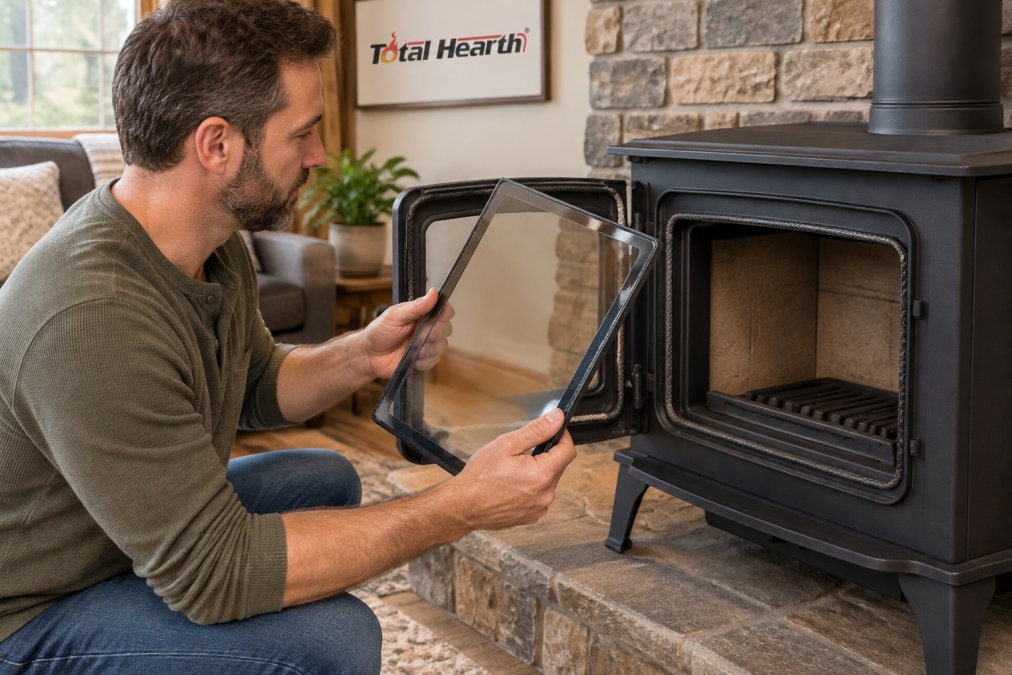
See the Jotul #3 ceramic glass panel for sizing and fit details.
For fan control, the ILS-3-8T variable speed blower control is a plug-in solid-state controller with a 7-foot cord. Check the blower controls section of the site for the listed electrical ratings and motor specification before ordering.
Why OEM Stove Replacement Parts Matter and Where Aftermarket Fits
OEM parts come from the appliance manufacturer and match the original specification. They are the safest choice when a part affects combustion, airflow or safety controls, because those systems were engineered and tested as a set. A burner orifice, a gas valve, a draft inducer or a control board that differs even slightly from the original can change how the appliance burns, vents or shuts off.
Aftermarket parts can be a practical alternative for gaskets, glass and controls when the reference and dimensions match. The trade-off is straightforward: aftermarket parts are often less expensive and more widely stocked for older appliances whose manufacturers have discontinued OEM support, but the burden of verifying fitment shifts to you. Compare the listed replacement references to your manual before you order.
A practical rule is to match the part to the consequence of failure. For cosmetic or sealing parts, door gaskets, knobs, handles, measure against the original part and confirm fit using your appliance manual and Total Hearth's how-to-measure guide before ordering. Stove glass is different: it must match both the material and the exact part specified for your stove model, not dimensions alone. For anything that controls fuel, ignition, flame sensing or venting, favor OEM or a part the seller explicitly cross-references to the OEM number. When in doubt, ask the seller's technical support to confirm the cross-reference in writing before you buy.
Seller reliability matters as much as part authenticity. Before ordering, check whether the listing states the part is genuine OEM or an aftermarket equivalent, and confirm the replacement reference against your manual.
Safety and repair difficulty deserve an honest assessment. Replacing a door gasket, glass panel or blower control is within reach for many homeowners with basic tools. Work on gas supply lines, gas valves, venting connectors or any electrical circuit beyond a plug-in controller is different: gas work carries carbon monoxide and fire risk, and electrical work at line voltage carries shock risk. Gas and hardwired electrical repairs are best left to a qualified technician. If a repair involves opening a gas line or working inside a control panel at line voltage, stop and call a technician.
Watch out: a part that looks the same can differ in temperature rating or profile. Never substitute standard tempered glass or a different gasket shape on a wood or gas appliance, and never install a gas component that is not cross-referenced to your model.
Ordering the Right Stove Part from Total Hearth
Start with your model and serial number, then match the original part number or reference against the product listings above. Measure gaskets and glass, and confirm the rated temperature and voltage. If you are unsure which part fits, contact Total Hearth's technical support with your model details before you order.
Ready to find your part? Shop ceramic glass and other stove components at Total Hearth, and match the material and exact part specified for your appliance before you order.
Frequently Asked Questions
Where can I buy stove replacement parts?
You can buy stove replacement parts from manufacturer dealers, specialty hearth retailers, large home improvement stores, and online parts suppliers such as Total Hearth. Online suppliers typically offer the widest selection of older and obscure models, while local dealers can help when you need a part the same day. Whichever source you choose, match the part to your model number before ordering.
Can I get stove parts at Home Depot?
Home Depot and Lowe's carry some common heating stove hardware, such as igniters, knobs, and general parts, but selection for wood, pellet, and gas stove components is often limited. For specialized items like ceramic glass, tadpole gaskets, or blower controls, a dedicated hearth parts supplier is usually the better option. Call the store or check its website to confirm stock before driving over.
Are OEM stove parts better than aftermarket parts?
OEM parts are made to the original manufacturer's specifications, which makes fit predictable, but aftermarket parts can perform equally well when they are built to the same dimensions and ratings. Confirm the replacement reference and dimensions against your owner's manual before ordering. The right choice depends on whether an exact match is required for your appliance.
How do I find the right replacement part for my stove?
Start with the model and serial number on the stove's data plate, then check the owner's manual or a parts diagram for the component you need. Compare the part number, dimensions, and profile of your original piece with the product listing. For gaskets, measure the complete path before ordering, since tadpole gaskets are sold by the running foot.
