 Free shipping for all U.S. orders over $100


Table of Contents
- Why Accurate Measurement Matters for Wood Stove Glass
- Tools You'll Need to Measure Wood Stove Glass
- How to Measure Stove Door Glass Dimensions: Width and Height
- Measuring Glass Thickness and Confirming Heat Suitability
- How to Measure Arched Stove Glass and Irregular Shapes
- Measuring When Glass Is Shattered or Missing
- Selecting Replacement Ceramic Glass for Wood Stoves
- Wood Stove Glass Gasket Replacement and Installation Prep
- Frequently Asked Questions
Last Updated: October 11, 2026
Why Accurate Measurement Matters for Wood Stove Glass
Learning how to measure wood stove glass and getting the right dimensions when you order replacement glass isn't just about convenience. It's the difference between a part that fits perfectly and one that leaves dangerous gaps or doesn't seal at all.
At Total Hearth, we've helped thousands of homeowners and service professionals order custom-cut ceramic glass. The single biggest mistake we see is people measuring the existing glass panel itself instead of the stove door opening.

Here's what matters: ceramic glass for wood stoves must fit snugly within the door frame with minimal clearance for thermal expansion. Too loose and heat escapes. Too tight and the glass can crack as it expands from temperature changes. Accurate measurements ensure safe operation and maximum efficiency.
The measurement process takes about 10 minutes and requires just a few basic tools. We'll walk you through exactly how to do it.
Tools You'll Need to Measure Wood Stove Glass
Essential measuring tools
You don't need expensive equipment. A standard tape measure and notebook are enough to get started.
Tape measure (25-foot minimum): A flexible metal tape measure is your primary tool. Cloth or plastic measuring tapes stretch and give inaccurate readings. Metal stays rigid.
Ruler or straightedge: A 12-inch ruler helps you measure smaller dimensions and check for straight edges. For arched glass, a flexible ruler works better than a rigid one.
Notepad and pen: Write down every measurement immediately. Don't trust your memory. Record the date and stove model too.
Calipers (optional but helpful): Digital calipers measure thickness more precisely than a tape measure. They're especially useful for confirming glass thickness, which typically ranges from 3/16 inch (about 5mm) to 1/4 inch (6mm) on wood stoves.
Optional but helpful items
Protractor: For arched or angled glass, a protractor helps document the angle. This is useful when ordering custom-cut glass with non-standard shapes.
Camera or smartphone: Take photos of the glass from multiple angles. Include a ruler or tape measure in the photo for scale. This helps when contacting a supplier with questions.
Stove manual or documentation: If you have it, the manual often lists the original glass dimensions. This serves as a verification check against your measurements.
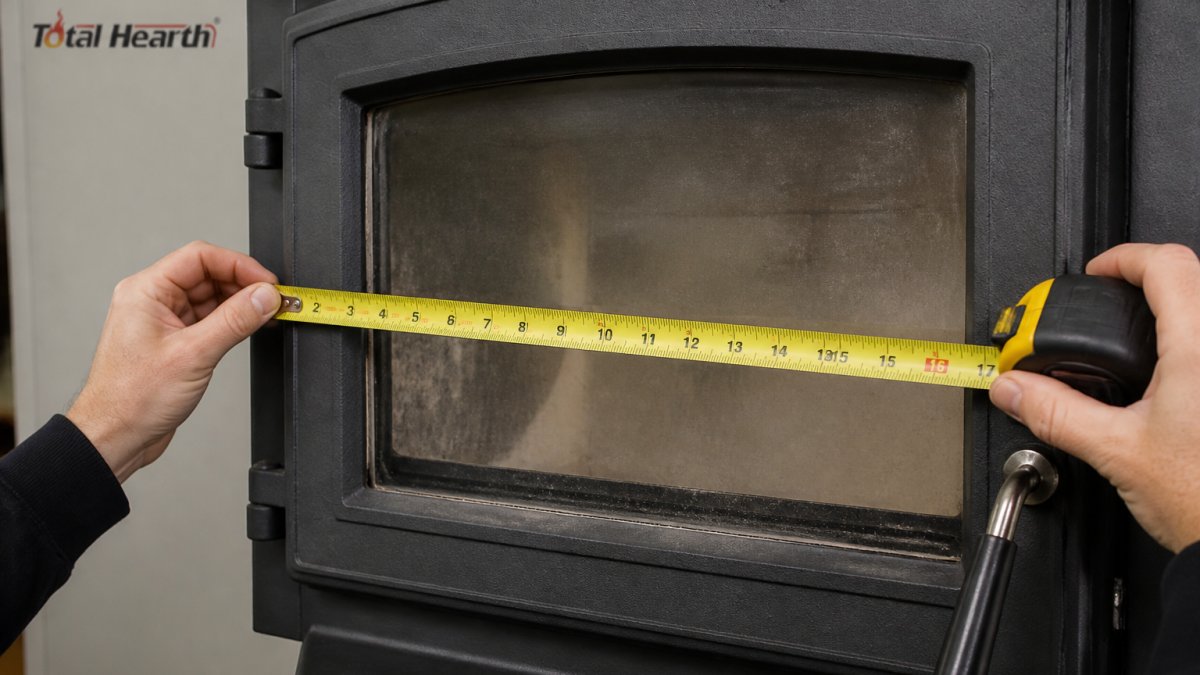
How to Measure Stove Door Glass Dimensions: Width and Height
Measuring width
Width is the left-to-right dimension of the glass panel.
Step 1: Remove the glass if possible. If the glass is already broken or loose, remove it carefully. Wear gloves to protect against sharp edges.
Step 2: Measure the stove door opening, not the glass itself. This is critical. Total Hearth advises measuring the stove opening rather than the old glass. The door frame is your reference point, not the existing panel.
Step 3: Record the measurement in inches. Write down the width to the nearest 1/16 inch. For example: 13 3/4 inches or 13 11/16 inches. Precision matters here because ceramic glass is custom-cut to your exact specifications.

Step 4: Measure at three points. Measure the width at the top of the opening, the middle, and the bottom. Older stoves sometimes have slightly warped frames. If the measurements differ, use the smallest dimension to ensure the glass fits.
Measuring height
Height is the top-to-bottom dimension of the glass panel.
Step 1: Measure from the bottom edge to the top edge of the door opening. Position your tape measure vertically. Start at the lowest inner edge of the frame and extend to the highest point.
Step 2: For rectangular glass, measure straight up. Record the distance in inches to the nearest 1/16 inch.
Step 3: For arched glass, measure to the highest point of the arch. If your glass has a curved or arched top (common on many wood stoves), measure from the bottom to the peak of the arch. This is your total height measurement.
Step 4: Measure at three points. Check the height on the left side, center, and right side of the opening. Record all three. Use the largest measurement to ensure the glass covers the full opening.
Measuring Glass Thickness and Confirming Heat Suitability
Glass thickness on wood stoves is typically 3/16 inch (5mm) or occasionally 1/4 inch (6mm). Thickness directly affects heat resistance and durability.
Why thickness matters: Thicker glass handles thermal shock better. When cold air hits a hot glass panel, the stress can cause cracks if the glass is too thin.
How to measure thickness: If you have the old glass, use digital calipers to measure the edge. Position the calipers on the glass edge and read the measurement.
Confirming heat suitability: Never use tempered glass in a wood stove. Tempered glass can only handle temperatures up to 400-500°F and will shatter if exposed to direct flame or rapid temperature changes.
When you order from Total Hearth, our custom-cut ceramic glass is always the right material for your application. We use Pyroceram ceramic glass that meets the demands of high-heat wood stove environments.
How to Measure Arched Stove Glass and Irregular Shapes
Measuring arch-top glass
Arched glass requires additional measurements beyond simple width and height.
Step 1: Measure the width at the base. This is your standard width measurement from the bottom corners of the arch opening.
Step 2: Measure the height to the peak. Extend your tape measure from the bottom center to the highest point of the arch. Record this measurement.
Step 3: Measure the arch radius (optional but helpful). For a true arch, the radius is the distance from the center point of the base to the peak. This helps the supplier cut the exact curve. If your arch is symmetrical, measure from the midpoint of the base straight up to the peak.
Step 4: Document the arch shape. Is it a smooth, rounded arch? A pointed arch? A gentle curve? Describe it in your notes. Take a photo if possible.
Documenting irregular or curved shapes
Some older wood stoves have non-standard glass shapes: sloped tops, corner cuts, or asymmetrical curves.

Step 1: Measure all straight edges first. Get your width and height measurements as described above.
Step 2: Identify where the shape deviates. Does one corner slope inward? Is one edge curved? Measure from the straight edge to the farthest point of the deviation. Record the distance and location.
Step 3: Use a flexible ruler for curved sections. Bend a flexible ruler to match the curve. Trace the shape on paper or photograph it with the ruler in place.
Step 4: Provide multiple reference points. For complex shapes, take measurements at several points along the curve.
Step 5: When in doubt, contact the supplier. Total Hearth accepts photos and detailed descriptions of irregular shapes. Our expert technical guidance can help you document measurements for custom-cut ceramic glass that matches your exact specifications.
Measuring When Glass Is Shattered or Missing
If your glass is broken or completely missing, the measurement process changes slightly.
Step 1: Measure the stove door opening directly. With no glass in place, you have a clear view of the frame.
Step 2: Check for any metal guides or gasket channels. Some stove doors have metal strips or grooves where the glass sits.
Step 3: Look for any remaining gasket material. Old gasket tape may still be in the frame.
Step 4: Measure the stove model and age if possible. Check the stove body for a manufacturer nameplate or serial number. This helps the supplier confirm the correct dimensions.
Step 5: Take multiple photos. Without the glass in place, photograph the opening from straight-on and from angles.
Step 6: Verify measurements twice. When there's no reference glass to compare against, double-check every measurement. Measure again the next day to confirm consistency.
Selecting Replacement Ceramic Glass for Wood Stoves
Why ceramic glass is essential
Ceramic glass is non-negotiable for wood stoves. It's engineered specifically for high-heat applications where tempered glass would fail catastrophically.
Ceramic glass (Pyroceram) has a coefficient of thermal expansion near zero. This means it doesn't expand or contract significantly as temperature changes. When a wood stove fire heats the glass to 1400°F and then cools rapidly, ceramic glass handles the stress. Tempered glass cannot. The internal stress from the tempering process makes it vulnerable to thermal shock. It shatters into small cubes when exposed to direct flame or rapid temperature changes.
Your safety depends on using the correct material. A wood stove with tempered glass is a fire hazard.
Fit tolerances and expansion clearance
Ceramic glass expands slightly as it heats. The gasket material and frame must accommodate this movement.
Expansion clearance: Ceramic glass typically expands about 0.1% per 100°F of temperature increase. For a 14-inch-wide panel heating from 70°F to 1400°F, that's roughly 1/8 inch of potential expansion.
Gasket thickness: Standard gasket tape is 1/8 inch to 3/16 inch thick. The gasket compresses slightly when the frame closes, creating a seal.
Measurement rounding: When ordering custom-cut glass, round your measurements to the nearest 1/16 inch. Don't over-specify precision.
Installation fit: When you install the replacement glass, the gasket should compress evenly around all edges. If one corner is tight and another is loose, the glass may crack under thermal stress.
Total Hearth's custom-cut ceramic glass comes with precise specifications. Our Pyroceram glass is manufactured to order in the USA and guaranteed to fit your exact measurements.
Wood Stove Glass Gasket Replacement and Installation Prep
Replacing the gasket while you install new glass ensures a proper seal and extends the life of your replacement panel.
Gasket material: Wood stove gaskets are typically braided fiberglass or rope-style material rated for high temperatures.
When to replace: If the old gasket is compressed, crumbly, or missing sections, replace it.
Removing old gasket: Carefully peel away the old gasket material from the frame grooves.
Measuring gasket length: The gasket runs around the entire perimeter of the glass opening. Measure the width, height, and any arch sections.
Gasket installation: Most gaskets are self-adhesive.
Glass installation: Once the gasket is in place, carefully set the glass panel into the frame. The gasket should compress evenly.
Final check: Before firing up the stove, verify that the glass sits flush in the frame with even gasket compression on all sides.
Measuring your wood stove glass correctly is the foundation of a safe, efficient replacement.
When you're ready to order, Total Hearth makes the process straightforward. We guarantee your glass arrives unbroken and ready to install. Shop Custom Cut Ceramic Glass and get your stove running safely again.
Frequently Asked Questions
Should I measure the glass itself or the stove door opening?
Measure the stove opening rather than the existing glass. Total Hearth advises measuring the door frame dimensions because the old glass may be warped, cracked, or incorrectly sized. Always follow your stove manufacturer's instructions or confirm the measurement method with the supplier before ordering replacement ceramic glass for wood stoves. This ensures your new glass fits safely and performs correctly.
What's the difference between ceramic and tempered glass for wood stoves?
Ceramic glass withstands continuous temperatures exceeding 1,400°F and has near-zero thermal expansion, making it safe for direct heat exposure in wood stoves. Tempered glass can only handle temperatures up to 400-500°F and will shatter if exposed to rapid temperature changes or direct flame. Always use ceramic (pyroceram) glass for wood stoves, fireplace inserts, and coal stoves. Tempered glass is only appropriate for fireplace screens with 4-6 inch clearance from the grate.
How do I measure arched or curved stove glass?
For arch-top glass, measure the straight width at the widest point (base), then measure the height from the base to the highest point of the arch. Use a flexible ruler or measuring tape along the curved edge to confirm the arch radius. For irregular shapes, create a paper template by tracing the existing glass or door opening, then transfer those dimensions to your measurement form. Document any angles or special features clearly when ordering custom replacement ceramic glass.
What clearance should I allow around replacement stove glass?
Ceramic glass expands slightly with heat, so allow a small clearance around the edges. Typical fit tolerances are 1/8 inch to 1/4 inch on each side, depending on your stove design. Check your stove's manual or contact the manufacturer for exact clearance specifications. Proper clearance prevents binding during thermal expansion and ensures safe gasket compression. When ordering custom glass, always verify these tolerances with your supplier before finalizing dimensions.