 Free shipping for all U.S. orders over $100


Last Updated: November 2, 2026
Quick Summary
Maintaining older fireplaces means checking the door gasket monthly with the dollar-bill test, inspecting firebrick for cracks, and booking an annual chimney inspection before heating season. Add a mid-season inspection if the unit is your primary heat source, and treat any change in flame, draft or smell as a reason to stop burning until a certified technician checks it.
- Empty the ash pan before each burn or when ash reaches 1 inch.
- Cracks under 1/8 inch in firebrick can be sealed; larger cracks need a pro.
- The CSIA recommends annual chimney inspections for all solid-fuel appliances.
- Use ammonia-free foaming cleaner on glass; ammonia sprays cloud ceramic glass and dry gaskets.
- Stop burning if you smell gas, see smoke backing into the room, or find a warped firebox.
Table of Contents
- Why Older Fireplaces Need a Different Maintenance Approach
- Your Older Fireplace Maintenance Checklist for the Season
- Fireplace Chimney Inspection and Cleaning: What to Check and When
- Cleaning the Firebox, Glass and Fire Screen Without Damaging Older Surfaces
- Fireplace Gasket Replacement: Restoring the Seal on an Aging Door
- Fireplace Glass Replacement: When to Repair Instead of Replace
- Gas, Wood and Pellet: Maintenance Differences by Fuel Type
- Warning Signs That Mean Call a Professional
- Frequently Asked Questions
Why Older Fireplaces Need a Different Maintenance Approach
Older fireplaces demand a different maintenance approach because their materials, seals, and clearances were built to standards that have since changed.
Homeowners with older wood stoves often rely on them as primary heat, which raises the stakes.
Here is the core problem most guides skip: best maintenance tips for older fireplaces cannot be copied from a new-unit manual.
Below, we walk through the seasonal routine, fuel-specific differences, and the warning signs that mean stop and call a pro.
Your Older Fireplace Maintenance Checklist for the Season
Most seasonal checklists are written for a five-year-old fireplace. An older unit needs the same tasks plus a second layer of age-specific checks, split between what you can do yourself and what a certified professional should handle.
Task |
Frequency |
Who Does It |
Why It Matters More on an Older Unit |
|---|---|---|---|
Empty ash pan and firebox |
Before each burn, or when ash reaches 1 inch |
Homeowner |
Ash holds moisture; older steel and cast iron corrode faster when ash sits through humid months |
Damper open/close check |
Weekly in season |
Homeowner |
A damper that sticks or no longer seals lets heat escape and can hide a blocked flue |
Door gasket dollar-bill test |
Monthly in season |
Homeowner |
Hardened gaskets are the most common cause of a stove that won't hold heat |
Glass soot check |
After each cool-down |
Homeowner |
Heavy soot on one side often signals a gasket leak or draft problem |
Firebrick and firebox visual inspection |
Monthly in season |
Homeowner |
Cracks under 1/8 inch can be sealed; larger or multiple cracks need a pro |
Blower and vent dust removal |
Monthly in season |
Homeowner |
Dust-clogged blowers overheat on older units with tired motors |
Smoke and carbon monoxide detector test |
Monthly, battery swap annually |
Homeowner |
Older appliances are more likely to develop combustion problems |
Chimney inspection (Level 1) |
Annually, before heating season |
Certified chimney professional |
The CSIA recommends annual inspections for all solid-fuel appliances |
Chimney sweep |
As needed based on inspection, often annually |
Certified chimney sweep |
Older masonry flues with rough liners accumulate creosote faster |
Level 2 inspection |
Before relining, after a chimney fire, or after any change in fuel type |
Certified inspector |
Required by many jurisdictions and wise on any unit over 20 years old |
End-of-season deep clean |
Once, after the last burn |
Homeowner |
Ash left through summer pulls moisture into the firebox and speeds corrosion |
Gasket replacement |
When the dollar-bill test fails |
Homeowner or technician |
Rope gaskets harden and compress with age; replacement restores the seal |
Daily and Weekly Tasks
- Check the firebox for ash buildup before each burn
- Confirm the damper opens and closes freely
- Look for soot streaks on the glass after cool-down
Monthly and End-of-Season Tasks
- Clean the glass with a non-abrasive product
- Vacuum dust from blowers and vents
- Test smoke and carbon monoxide detectors
Ash left through humid summer months pulls moisture into the firebox and speeds corrosion on older steel.
How Age Changes the Schedule
A fireplace built before the 1990s was likely constructed to standards that have since been revised, and many of its components, gaskets, firebrick, dampers, glass, were not designed to last three decades. The unit is not necessarily unsafe, but the schedule above is a minimum, not a ceiling. Three adjustments matter most:
- Add a mid-season inspection if the unit is your primary heat source. A single annual visit may not catch a liner problem that develops during a heavy burn season.
- Shorten the gasket check interval on any stove older than about 15 years. Gaskets harden with heat cycles, and a seal that passed the dollar-bill test in October can fail by January.
- Treat any change in behavior as a trigger, not a calendar event. A new rattle, a slower draft, or a flame that looks different is a reason to inspect now rather than wait for the next scheduled task.
Homeowner Checks vs. Professional Inspections
The line between the two is clearer than most guides suggest. Homeowners can safely handle ash removal, glass cleaning, gasket testing and replacement, blower dusting, and visual firebox checks. A certified chimney professional should handle anything involving the flue interior, chimney structure, liner, or the appliance's connection to the venting system. The CSIA's three inspection levels are a useful frame: a Level 1 covers readily accessible portions of the appliance and venting; a Level 2 includes accessible portions of the chimney interior and is appropriate after a chimney fire, a change in fuel type, or a relining; a Level 3 is reserved for concealed areas.
Fireplace Chimney Inspection and Cleaning: What to Check and When
Chimney inspections should happen at least once a year, and older fireplaces often need a second look mid-season. The Chimney Safety Institute of America inspection guidance recommends annual inspections for all solid-fuel appliances.
What to check:
- Creosote buildup on flue walls, especially glazed creosote
- Blockages from nests, leaves, or a collapsed liner
- Liner condition for cracks or gaps in older masonry flues
Cleaning is a separate job from inspection. A sweep removes soot and creosote; an inspector grades the flue. Older chimneys with unlined masonry need extra scrutiny because a cracked flue tile lets heat reach nearby framing.
For wood-burning systems, a creosote conditioner used between professional visits can help reduce buildup. A creosote conditioner such as Supersweep Creosote Conditioner can be used as part of a regular cleaning routine, but it does not replace sweeping.

Supersweep Creosote Conditioner – 1 lb Powder | KK0153 | Chimney Cleaner for Wood-Burning Appliances | Imperial Manufacturing
Cleaning the Firebox, Glass and Fire Screen Without Damaging Older Surfaces
Harsh cleaners ruin older fireplace surfaces fast. Ammonia-based glass sprays can cloud ceramic glass and dry out door gaskets. Abrasive pads scratch the viewing window permanently.
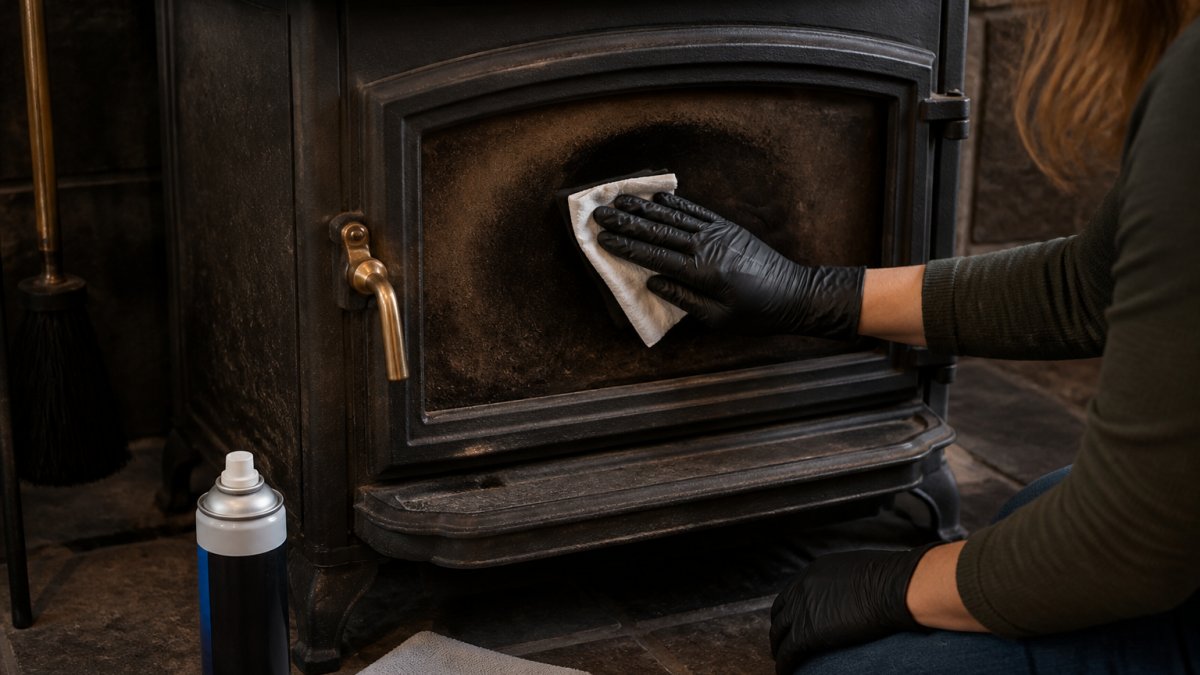
Gloved hands wiping soot from a cast iron wood stove glass door with foam cleaner and a cloth
Start with the firebox. Let the stove cool completely, then scoop ash into a metal container, never vacuum warm ash.
For glass, use an ammonia-free foaming cleaner like Total-Hearth Stove Glass Cleaner. For a chemical-free option, the Atmosfire Dry Wiper is a non-scratch dry cleaner designed for ceramic glass.


Wipe the fire screen with a soft cloth. Skip metal polishes on older plated screens, since they strip the finish.
Fireplace Gasket Replacement: Restoring the Seal on an Aging Door
A worn gasket is the single most common cause of a stove that won't hold heat. The dollar-bill test tells you quickly: close the door on a bill, and if it slides out easily, the seal is shot.
Replacement steps:
- Let the stove cool and remove the door if possible
- Pry out the old gasket and scrape the channel clean
- Apply high-temp cement into the channel
- Press the new rope gasket into place, working around the door
- Trim the ends and let the cement cure before firing
For a complete kit, the Arrow 5/8in Door Rope Gasket Kit includes 7 feet of fiberglass rope gasket with graphite embedded and a tube of adhesive. If you only need cement, Imperial KK0076 Gasket Cement is rated for continuous exposure up to 2,000°F.
Measure the old rope before ordering so the new gasket matches.
Fireplace Glass Replacement: When to Repair Instead of Replace
Cracked glass means stop burning until it is replaced. A single hairline crack can spread with heat and shatter the door.
Replace the glass when you see:
- Cracks or chips along the edge
- Cloudiness that cleaning won't fix
- A loose or warped retaining frame
For an older unit with a discontinued glass size, custom-cut glass may be an option.
Before you order, measure the opening, note the glass thickness, and check the tape gasket. A Universal Glass Tape Gasket reseals the new pane against the door frame.
Gas, Wood and Pellet: Maintenance Differences by Fuel Type
Each fuel type has its own failure points, and on an older unit those are shaped by age as much as by fuel. Treating a 30-year-old wood stove like a gas insert, or vice versa, is how problems get missed.
Fuel Type |
Key Checks |
Frequency |
Watch For |
Age-Specific Concern |
|---|---|---|---|---|
Wood |
Creosote, gasket, firebrick, damper |
Weekly in season |
Glazed creosote, cracked brick, warped firebox |
Unlined masonry flues and hardened gaskets |
Gas |
Pilot light, gas line, logs, venting |
Monthly |
Yellow flame, gas smell, soot on logs |
Corroded burners and obsolete safety pilots |
Pellet |
Blower, auger, ash pan, vent pipe |
Weekly in season |
Clogged vent, motor noise, incomplete burn |
Worn auger motors and ash-filled heat exchangers |
Wood-Burning Units
Wood stoves and masonry fireplaces live or die on three things: creosote condition, gasket seal, and firebox integrity. Creosote forms when smoke cools before it leaves the flue, and older masonry chimneys with rough or unlined interiors give smoke more surface to cling to. Glazed creosote, the shiny, tar-like stage, is the most dangerous because it is hard to remove and burns hot. A creosote conditioner used between professional sweeps can help reduce buildup, but it does not replace sweeping. Supersweep Creosote Conditioner is one such product.
The gasket is the second failure point. A hardened rope gasket lets air in around the door, raising the burn temperature unpredictably and warping an older firebox; the dollar-bill test is the fastest check. Firebrick is the third: hairline cracks are common and often harmless, but cracks wider than 1/8 inch or running across multiple bricks can let heat reach the stove body or nearby framing.
Gas Units
Gas fireplaces and inserts have fewer user-serviceable parts than wood units, but the checks that matter are different. Before any cleaning, confirm the gas shutoff valve works and know where it is.
Venting is the other age-related concern. Older gas inserts may vent through a liner that has corroded or separated, and a blocked vent can push combustion byproducts into the room.
Pellet Units
Pellet stoves need blower, auger, and vent checks plus a clean ash pan. The auger motor and blower bearings wear with age, and a motor louder than it used to be is often the first sign of a failing component. A clogged vent pipe causes incomplete burns and smoke in the room; on older units, inspect the vent at least once a season and clean as needed.
If you own a gas insert, our guide to 7 preventative maintenance tasks for gas fireplace inserts goes deeper on fuel-specific care.
Warning Signs That Mean Call a Professional
Some problems are beyond DIY. Stop using the fireplace and call a certified technician if you notice any of these:
- A strong gas smell near a gas unit
- Smoke backing into the room during a burn
- Cracked or crumbling firebrick across multiple bricks
A common mistake is patching a firebox crack with furnace cement and calling it fixed. Small gaps under 1/8 inch can be sealed, but structural cracks need a pro. The U.S. Fire Administration home fire safety guidance is clear that chimney fires are preventable with proper maintenance.
For readers new to fireplace care, our blog covers more on wood stoves and seasonal upkeep.
Frequently Asked Questions
How often should an older fireplace be inspected?
Most safety guidance points to an annual inspection by a certified chimney professional, and older fireplaces benefit from sticking to that schedule even in years with light use. Creosote, cracked firebrick and loose gaskets build up silently. If you burn wood as a primary heat source, add a mid-season check. Between professional visits, inspect the firebox, door seal and flue opening yourself each month during heating season.
What are the signs that older fireplaces are unsafe to use?
Stop burning and call a professional if you notice smoke spilling into the room, a strong creosote smell, cracked or crumbling firebrick, rusted or loose flue sections, or a door that no longer seals. Soot streaks above the firebox opening and a flame that pulls oddly toward the room are also red flags. Older fireplaces with unlined or damaged flues should not be used until inspected.
How do I know when fireplace gaskets or glass need replacing?
Test the gasket with the dollar-bill trick: close the door on a bill and pull. If it slides out with no resistance, the seal is worn. Visible fraying, flattened rope or hardened adhesive also signal replacement. Glass needs replacing when you see cracks, chips or clouding that cleaning will not remove. Measure the opening and order a custom-cut pane matched to your model rather than forcing a universal size.
Can you use an older fireplace before having it inspected?
It is safer to have any older fireplace inspected before the first burn of the season, especially if it sat unused for a year or more. An inspection catches blockages from nests, cracked firebrick and creosote buildup that a visual glance will miss. If you must burn before an appointment, keep a window cracked, confirm the damper opens fully and stop immediately if smoke backs up.
Older fireplaces ask more of you, but they reward the effort with reliable heat and a safer home. Total Hearth helps you keep an aging appliance running with custom-cut ceramic glass, gasket kits, and hard-to-find parts. Our team offers expert technical guidance, parts guaranteed to fit your exact specifications, and fast shipping to your door. Get started with Total Hearth and give your older fireplace the parts it needs to last another season.
